Showing posts with label family. Show all posts

Thursday, October 24, 2013

If I Made a Million Dollars

by Cecilia (age 8 and apparently the future patron saint of old house lovers)

(click the picture to view larger)

Sunday, May 13, 2012

For You, Mom

You've been asking for another post here for a few weeks now and since you're on the opposite side of the country right now and any other gift will have to wait until you're home, here's an Einsel House post for you today.  Happy Mother's Day! : )

The basement windows at this house have been an issue as long as we have owned the place.  Previous owners raised the level of the yard in front of the house by about a foot, basically covering the basement windows on the west and north sides of the house.  When we bought the house the west facing basement windows (front of the house) had been removed and the holes filled with concrete.  The concrete is immediately obvious from inside the basement, but when outside the only evidence of the former windows still visible are the original window lintels, which are now right at the soil line.

The west facing basement window had not been removed, but it was in a sorry state when we bought the house.  Poor drainage coupled with a poorly sloped yard meant that whenever it rained water funneled to this window, pouring through into the basement below.  By the time we bought the house the sill for the window was completely gone and the two sides of the window frame were half rotted away.   The window itself was still in place, but we removed it in 2009 to stop it from further deterioration.  Then, because we had other more pressing issues during those late days of 2009, we temporarily "fixed" the resulting opening in the side of the house with a piece of foam board secured in place with liberal amounts of expanding foam.  (Classy, I know.) Outside, we covered the atrocity with a straw bale.

And so remained until this spring.  On one of our nice March days I pulled back the straw bale and dug out the long abused window.  Charles helped to break loose the foam board, and then we stood back and looked at the result:


Not very inspiring results for an afternoon of hard and dirty work.  But it was at least a starting point. 

(On a side note - I was surprised to uncover the poured concrete window well that is visible in the pictures.  It gives a good idea of the original level of the yard prior to it being raised by previous owners.) 

The nice weather in March gave way to a cold and wet April, so the straw bale (partnered with some plywood this time) went back over the gap in the house.  Meanwhile, I cleaned up the original three light window.  What had been the bottom exterior side was partially rotted, so I removed what was too far gone and treated what remained with a rotted wood stabilizer.  I also decided that when reinstalled I would rotate the window, so that the former exterior bottom (most exposure to water/weather) would become the interior top (least exposure to water/weather).  With the window primed and under one coat of paint I got to try my hand at glazing - and found I rather enjoyed it.  Luckily we had enough correctly sized panes of old glass to put two panes in each of the window's lights.  Another coat of paint, and the window was ready to go.  The frame was another story.

After taking the pictures above, I pried out what remained of the two sides of the frame.  They were too far rotted to try to save.  Each piece was a true 2" thick and 11" wide.  I called the local specialty lumber shop, but the owner said he could manage either 2" thick OR 11" wide, but in order to do both he would need to glue pieces together.  That didn't sound like a good idea for wood that was going to be used in a basement window frame below grade.  At my mom's suggestion (Hi, Mom!) she and I went back up to the old Second Empire house we salvaged bricks from last year.  This time we salvaged wood.  While we didn't find any 2x11 boards, we did bring home a 2 x 9 1/2 that we thought we could make work.

With mom's help, we cut pieces for the new window frame.  Under the gray weathered surface of that old wood was beautiful quarter sawn oak.  I commented to mom that you'd never find 2 inch thick quarter sawn oak used to frame a house today.

Back at the Einsel House, I decided to dry fit the pieces we had cut for the new frame before painting them.  That turned out to be a good idea.  At some point during that long afternoon I decided that it was definitely easier for the Einsel House's builders to build the stone walls around the already constructed window frame than it was for me to try to fit a new frame into the already constructed stone walls. When I finally got everything to fit together nicely, I pulled everything back out.  Since this wood will all be below grade I wanted to prime and paint all sides of each piece before installing them for good.

The remaining steps took almost another two weeks, but I can type them out much more quickly:

-seal, prime and paint (2 coats) the new sill and frame
-assemble frame in wall
-fill remaining gaps in top board with epoxy filler, sand, prime and paint (2 coats)
-install repaired window
-tuck point gap between the stone walls and new frame (I called our mason who gave me the correct mortar recipe for this step)
- build a stone retaining wall to bring the window well up to the current level of the yard

And, as of late yesterday afternoon, here is the "new" window:


I'm very pleased with this.  
So pleased I may even take my lunch outside today and eat it while admiring my work.  : )   


Monday, April 2, 2012

Spring Projects

For the past few weeks I've been anxiously watching the weekend weather forecasts, fingers crossed for good weather.  I've got multiple projects started and more that I'm itching to start.  But a few days ago Charles politely suggested that perhaps I should finish a current project (or three) before I take on anything new.  He's probably right -  if because if there's such a thing as DIY-ADHD than I've definitely got it. 

About a month ago I finally gave up on the blue paint in the kitchen.  I had high hopes for it in the beginning, but after two years I had to admit it wasn't growing on me.  It took several tries to find a new color for the room - the pale yellow in the picture to the left lasted only a few days before being painted over with a more tan/gray beige.  Schwartz, by the way, loved having an 8 foot ladder in the kitchen.

Other recent interior projects included Cecilia's quilt - finished last weekend - and the living room baseboards.  The latter project has been delayed by attempts to match the color of the new baseboard to the original walnut trim.  A local paint store has graciously allowed me to take home various stains, and I'm getting closer but still not quite satisfied enough to finish the new baseboard.

Outside, I spent the first nice day this spring digging out a basement window on the north side of the house.  The yard around the house was raised a foot by previous owners and the basements windows (at least the ones that were not filled in with concrete) were in desperate need of attention.  We had temporarily dealt with this by blocking the windows with heavy foam board secured around the edges with expanding foam.  Classy, I know.  But the remaining north facing window is now dug out and ready to be rebuilt. 


The first layer is topsoil added by a previous owner.  The middle layer is concrete window well poured before the level of the yard was raised.  Below is a closer view of the window opening.  The window sill is completely gone and both sides are rotted beyond repair.

The window itself was salvageable and is currently resting in my mom's wood shop.  I replaced several panes of broken glass, reglazed the window, and primed it.  Cecilia put a first coat of paint on it tonight.  Our masons left a bag of mortar, so as soon as I get more cooperative weather I'll tackle rebuilding the window sill.

In the meantime I've continued on the shed project.  With help from Charles and my mom one of the doors built over the winter is now hung on the shed.


The bottom and inside edges of the door will be cut to size once the second door is hung, but I'm already so tickled with how this is looking. 

And finally, one last project that's in the works.  I've got my mom to thank for this again.  Over the winter she rebuilt the sashes for the springhouse windows.  They're in her workshop now (with the basement window) primed and ready for paint.  But before I primed them mom brought them over to be sure they fit the springhouse.  This is just a hint of what the finished windows should look like, but I'm pretty tickled with this as well.


Based on the forecast for this weekend hopefully I'll be able to share a bit more progress on these projects soon.  :  )


Sunday, February 26, 2012

Fourteen Months Later....

I got a phone call from my mom after church this morning asking if she could stop by with some sections of baseboard for our living room.  (A mere fourteen months after the last post on this topic here.)  I had no idea my mom had been working on these and the unexpectedness of her surprise made it even more exciting to see the boards against the wall and marked to length.  As I explained in my earlier post, recreating the profile on the upper portion of the baseboards proved to be a challenge.  But I'm lucky enough to have a mother employed at a woodworking shop and in the end her boss recreated the profile by hand - and did an excellent job.  Side by side, the new baseboard is an almost perfect match to the original.  For local readers who need any custom woodwork I highly recommend Brad's Woodworks of Attica (and not just because my mom works there!)


Other projects are progressing as well.  The shed doors are resting in the shop, just waiting for a nice weather day to hang them.  I'm anxious to see the doors and their hardware on the shed.  (But not quite anxious enough to stand outside in late February weather to install them!)

And Cecilia's quilt top is all pieced.  I'm using a darning foot for the first time to quilt it.  It's definitely a learned skill, but I'm having fun with it and I'm pleased with the results to far.

 Lastly, I've been lax in introducing our new house cat.  
Meet Schwartz, the luckiest of Ethel's litter from last spring:


The kids think Schwartz has been a great addition to the family.  
Tiny the Cat is a bit less enthusiastic, though.  : )

Friday, September 16, 2011

Creative Financing

We’re approaching the two year anniversary of a very nerve-wracking period here. The earliest posts on this blog recount the whole story in detail, but I’ll give the cliff notes version here. Basically, to say we bought the  Einsel House in an unconventional manner is an understatement.


Thursday, August 27, 2009 – Charles and I are the only bidders for the Einsel House when it is sold at sheriff sale. Immediately after the sale we find out there was an attorney who was supposed to bid for the bank, but he basically wasn’t paying attention and never placed any bid.

August 27-September 19, 2009 – Charles and I wait anxiously for closing (which we are told takes 6-8 weeks)

September 20, 2009 – Our attorney gets a phone call from the office of the attorney who didn’t bid at the sale. That attorney offers us $ to rescind our bid. If we refuse he threatens to contest the sale.

A few days later I wrote here, “So in the end we are not that concerned about losing the Einsel House. The main difficulties have to do with time and money. And lack of sleep. I'll elaborate on the "time and money" stuff later…”. Well, it’s two years later, and we obviously did get the house, and it feels now like a good time to finally share some of the details I withheld back then.

Anyone who has read here regularly already knows that we owe my parents (particularly my mom) a huge thank you for all of the help they have provided at the EH, especially during those first nine months. But what regular readers here don’t realize is that we are indebted to my parents for more than just their time and labor. We also owe them innumerable thanks for their trust in Charles and me. That is because much of the money spent on the Einsel House during those first nine months was money borrowed in my parents’ names and borrowed against their house.

Charles and I have always been conservative financially. When we started looking at houses we went to the bank regarding preapproval for a loan. We told the loan officer how much we planned to borrow, he took our information, pulled our credit scores and immediately said, “That will be no problem!”. The bank loved Charles and I, but it turns out we were only half of the equation; the other half was the Einsel House. And the bank wasn’t nearly as enthusiastic about the EH. It made no difference how high our credit scores were; with a patchwork roof, peeling paint, crumbling drywall and no furnace there was no way the Einsel House would qualify for a conventional loan.

Our loan officer said we would probably qualify for a construction loan (portfolio loan I think he called it), but the extra hoops such a loan would require made Charles and me very cautious. As I understood it, with a construction loan the bank would have to review and approve everything we did to the house. We would have to provide the bank with documentation that all work was done by licensed, insured professionals and we would have to have quotes approved by the bank before any work could begin. Trying to renovate the house with a bank looking over our shoulder through the entire process did not sound fun at all.

Enter my parents - who had a house that would easily qualify for a conventional loan. When we brought the possibility up with our loan officer I think he was somewhat taken aback, but he said that from the bank’s perspective it would be no problem. If my parents’ house and personal credit both qualified, the bank really didn’t care how the money was spent. So my parents applied for a home equity line of credit in their names, and with their house on the line. The plan was to use the HELOC to make the repairs needed in order for the Einsel House to qualify for a conventional loan. Charles and I would be responsible for all fees and payments required on the HELOC, and once the Einsel House was up to par we would refinance it in our own names, using the proceeds to pay off the HELOC in my parents’ names.

The paperwork for the HELOC against my parents’ house went through without any complications, and on September 17, 2009 they signed their names opening the line of credit. We were all set for our closing on the Einsel House – until three days later when we suddenly had an attorney threatening to contest the sale.

This added a whole new set of complications to the situation. The line of credit through my parents was set up and ready to go, and from that front we were still able to close and start repairs. But the attorneys I work for cautioned us strongly against putting any money into the house with the possibility of litigation hanging over us. Although they felt that we stood a very good chance of keeping the house in a court battle, they said that if the sale was somehow reversed we would probably lose any funds invested in the building above the purchase price. The courts would say that any improvements we made to the house while it was the subject of ongoing litigation were a “known risk” and if we lost the house we would also lose any money spent on improvements. Legally, the safest thing would be to close on the house, but then not put any more money into it until we were sure we were not headed to court. But it was already late September, and the house in question had no furnace and needed obvious structural repairs. There was no way we wanted to let it sit empty through the approaching winter.

The loan officer at our bank had more bad news. The home equity line of credit through my parents was still there, and the bank still didn’t care how that money was spent. But our loan officer warned us that the bank would never approve a refinance on a property that was the subject of ongoing litigation. This meant that even if we took our chances and made the necessary repairs to the Einsel House we would not be able to refinance it until any possible litigation was resolved. This was concerning for two reasons. First, the HELOC had an adjustable interest rate and we wanted to be able to refinance as soon as possible to secure a fixed rate. Second, Charles and I were planning on a conventional 30 year loan when we refinanced; but the HELOC was based on a 10 year amortization. This meant that our monthly payments on the HELOC were more than double what they would be following a refinance. We were prepared to make those payments for awhile, but being tied to those payments indefinitely was very concerning – especially because it was technically my parents who were on the line.

The attorneys I work for were quite confident that if push came to shove case law would ultimately uphold our purchase of the Einsel House. But they warned that even if we ultimately prevailed in court, it could take a long time to get there. The attorney opposing the sale was the senior partner in a multiple member firm. Even if he knew he would lose, it would cost him nothing but time if he chose to be a thorn in our side (and we had no reason to doubt that he would).

In the end we bought the other attorney’s cooperation by paying him an amount equal to half of his malpractice insurance deductible in exchange for his signature on a "Covenant Not to Intervene or Interfere in Sale." Considering the alternatives it was a concession we felt we had to make. And in the end it did all work out. We closed without complications on the Einsel House on October 7, 2009. For eight months we made payments on the line of credit open in my parents’ names, and in June, 2010 we closed on the refinance of the Einsel House, paying off the HELOC and settling into a conventional fixed rate 30 year mortgage.

It’s a little bit surreal to recall the emotional highs and lows surrounding our purchase of the Einsel House.  If I were making the whole story up I don't think I could have put more twists and turns along the way.  Looking back, I remember the last advice my dad shared with me on the morning of the sheriff sale -  "Just relax," he said, "if it's meant to be it will be".  And in the end, I'm so glad that he was right.

Friday, September 9, 2011

Curiosity and the Cat

I've moved from roofing to siding. Labor Day was spent on the west side of the shed.  I took down the corner boards, then took out and framed in the old window.  My father-in-law helped me wrap that side in tar paper, and then we put up four rows of furring strips.  The existing siding is very rotted, so we'll rely on the furring strips (which are screwed into the shed's very solid framing) to hold on the new siding.


By mid afternoon we had the first three pieces of siding cut to size and the kidlets were set up with paint brushes and a pail of primer.  If you look carefully at the picture to the right you will see that Neil's attention is not on his paint brush but instead on a kitten who came to help.  I figured there would be curious kittens and had warned the kids to gently move any kitties that came too close.  Two kittens acted as I predicted, cautiously creeping up the project, sniffing curiously at the primer's strange smell. And Neil did an excellent job redirecting. 

But one kitten acted in a way I definitely did not predict.  Throwing caution to the wind, Maude's most adventurous kitten approached the kids at a full run and without pause jumped . . . . straight into the gallon of primer.  Poor Neil didn't even have a chance to intervene.  

The poor kitten jumped back out almost immediately, leaving a splat of primer on the grass.  It clearly wanted to escape, but rather than running it executed a series of quick sideways leaps, leaving more splats of primer on the grass.


The next 15-20 seconds were pandemonium.   I was attempting to catch the kitten, which was still pathetically jumping through the grass.  The kids were screaming and yelling, and my father-in-law was laughing out loud.

Meanwhile, there were several thoughts running through my head:
1 - we can't let this kitten try to lick itself until we wash off this primer
2 - Crap! We can't just wash this off, it's an oil based primer!
3 - I think I better call a vet and see what they suggest
4 - Crap!  It's Labor Day and I'm sure the vet's office is closed

With the kitten wrapped tightly in an old rag, I dialed our veterinary's phone number.  As I feared, I got a message that the office was closed, but I left a message explaining our predicament.  I then held the kitten while praying that the vet would call back before the primer completely dried.  Luckily, she did.  The vet said to go ahead and use paint thinner to wash off as much primer as possible, and to follow immediately by a thorough washing with dish soap in warm water. 

By this time the kitten had pretty much resigned itself to its fate.  Using a rag soaked with paint thinner I carefully rubbed down all four legs, and then turned my attention to the very round kitten belly which was also covered in primer.  Luckily, the kitten's head and back were mostly clean.  I then switched to a warm dishwater bath.  By the time I was done the kitten was a pathetic little sight.  And it was shivering.  The day was chilly, so we put our now very contrite kitten up in a small cage in the kitchen for the night.  Besides keeping the kitten warmer while its fur dried, I also wanted to keep the kitten isolated.  I had done my best on the two baths, but I was still worried that the kitten might get sick when it began trying to clean itself.  I also didn't want Maude to get herself sick trying to bathe her kitten.  The kitten sat shivering in a corner of the cage and gave a few mournful meows.  After a few minutes I coaxed it into eating and drinking a bit. 

The next morning I woke up a bit early and walked with some trepidition across the quiet kitchen.  But when I lifted the towel draped over the cage the kitten (now christened 'Primer') stood up, stretched and meowed.  I took her out of the cage and gave her another good combing - during which I realized with a smile that Primer is learning how to purr.  Apparently having nothing worse than a slightly matted coat to show for her adventure, later that morning I returned Primer to her siblings and mother in the barn.

Hopefully Primer has shared her lesson with all of our other kittens and we won't have a repeat performance when we break out the red paint this weekend.  : )

Friday, August 12, 2011

Salvaging Barn Siding

 
Earlier this week we got permission to start salvaging siding any time.  We planned to start tomorrow but after learning that the contractor who is tearing down the barn also has permission to start his work any time, we decided we could fit a few hours of work in tonight.   Many thanks to my parents for their help.  We have much more of the same ahead of us tomorrow. 


I took the above picture shortly before we left tonight.  I like the lighting in it.  Although I am thrilled to be getting siding for our own shed, there's still a sadness to realize that this old barn will soon be no more. 

Tuesday, August 9, 2011

Updates, Updated

As the lack of posts here shows, I've not accomplished anything around the house lately.  But this time I have a good excuse - I spent the better part of 10 days one thousand miles from the Einsel House, and the lesser part of 10 days driving there and back.

I do have a few bits of news I can share though.  First, weeds can do an astonishing amount of growing in 10 days.

Second, thanks to my dad (and the wonderful brothers who now farm my parents' land) it looks like I again have barn siding to salvage for my shed project. 

Third, we have an estimate to deal with the flooding problems at the end of the drive.  However, we asked the county engineer's office for a second opinion and after looking at the problem they said any tile would be mostly a waste of money for two reasons - (1) it would need to be extremely large to deal with the heavy downpours that cause the problem and (2) because of where it would need to be located, any tile would quickly plug with chaff and other debris from the field.  The county engineer suggested with either (A) relocate the end of our driveway 20 feet or so south, or (B) wait until the current soybean crop is harvested so we have a better view of the problem area and then reassess the situation.  We're going with B.

Fourth, we still have kittens.  A dozen kittens to be exact.  Ethel amazed all of us, not only by having 7 kittens in her first litter, but also by managing to keep all seven growing and healthy.  If you're local and want a cuddly little buddy, let us know!

Fifth, although it was never mentioned here, I spent most of July trying to convince Honda to pay for a $2,000 repair needed on our van.  I had to fight way too hard for it, but just before crossing the Mackinac Bridge last Friday we got a call saying Honda has finally agreed to cover the necessary repairs!   This means we should still be able to have the back of the house repointed this year!

Toes in Lake Superior
And finally, a few highlights from our recent trip.  For Charles and I's tenth anniversary, my in-laws rented a cabin on a lake in northern Minnesota.  My father-in-law has made the trip annually for 30-odd years to visit both a friend made in Vietnam days and Minnesota's deer.  (Denny is always much happier to see Jim than the deer are.)

Fishing with her Grandpa


Neil enjoying table ball at the resort's play area

Every six year old girl's dream


Tuesday, June 28, 2011

A Busy Weekend

The new awning on the shed went up last weekend.  Most of the prep work was done weekday evenings last week.  I couldn't see anything wrong with the construction of the old awning (other than the fact that it had rotted away because it was never finished), so while dismantling it I kept some parts to use as patterns for the replacement roof.  Using these patterns, by last Friday I had the new joists all notched and angled, and the sistered joists for each edge of the new roof assembled.
On Saturday morning the framing for the new roof went up remarkably easily.  I was sidelined for an hour and a half over lunch while my drill battery recharged, but even with this delay by two in the afternoon the shell of the new awning was up.  


Sunday's work was more challenging.  With me on the roof and Charles on the ground, we lugged up sheets of plywood for the roof deck.  Because it was a Sunday, we didn't start work until about 11am.  But we worked pretty much straight through until around 8 that evening.  By then the plywood was all up and most of it was under tar paper.  For now, the project is on hold for the next few days while we explore our options. 

The original plan was to shingle the new awning roof and recoat the original metal roof over the shed itself.  That may still be the route we take, but before I climb back up onto that roof we're going to get some estimates at having a new metal roof put on the entire building.  The reasons are several. 

1 - We already bought three gallons of rust inhibiting primer for the existing metal roof, and wow is that stuff expensive!  By the time we prime and paint the existing roof we will have around $300 already invested, and shingles for the awning roof will add to this figure.  Although the current metal roof seems solid, I would hate to put that much money and work into recoating it only to have the rust pop through again a couple years down the road. 

2 - I've been skeptical all along about how the roof would look half standing seam and half shingle.  If we're going to have to invest a decent amount of money in this regardless, I think it would look better to have the entire roof be metal.   

3 - Despite doing a lot of it lately, I still don't like crawling around on the roof. 

4 - My parents have offered to contribute some of the cost of a new metal roof as an anniversary/early Christmas gift.  (I suspect this offer was made partly because my dad doesn't like the idea of his only daughter crawling around on the roof any more than his daughter likes doing the crawling.)


I've got my fingers crossed that estimates for a new roof are not too absurd. 

Tuesday, June 21, 2011

Ancestors, Indians, and Johnny Appleseed


I shared some family history with the kids on our trip to Mohican State Park a couple weekends ago, and since persistantly cloudy and periodically thundery weather has hampered work on the shed, I'll share my story of Indians, the War of 1812, Johnny Appleseed, and Neil & Cecilia's great, great, great, great, great, great grandparents (that's six greats if anyone lost count) here as well.

John & Anne Catherine (Smith) Lambright were married at Frederick, Maryland in 1802.  A list of their nine children with their years and places of birth reads as follows:

1 - John Lambright, born in 1805 in Frederick County, Maryland
2 - Margaret Ann Lambright, born in 1807 in Frederick County, Maryland
3 - Levi Phillip Lambright, born in 1810 in Frederick County, Maryland
4 - Henry Lambright, born in 1812 in Richland County, Ohio
5 - Catherine Lambright, born in 1814 at Lancaster, Fairfield County, Ohio
6&7 - twins David & Michael Lambright, born in 1817 in Richland County, Ohio
8 - Rachel Lambright, born in 1819 in Richland County, Ohio
9 - Elizabeth Lambright, born in 1822 in Richland County, Ohio

Twins are always something of a novelty, but what stands out in this list for a genealogist is John and Anne's fifth child, Catherine.  Specifically, Catherine's place of birth.  The family obviously moved from Frederick County, Maryland to Richland County, Ohio sometime around 1811.  So why was Catherine born at Lancaster? 

The answer to that question precedes Catherine's birth by a couple of years.  With the outbreak of the War of 1812 there was concern that Indians living in Ohio, encouraged by leaders like Tecumsuh, would join the British in the struggle and be incited to attack white settlers.  The Lambright family at this time was newly settled in their home Richland County (the area is now part of Ashland County).  Located near them was the Indian community of Greentown.  According to a local history published later in the 19th century, the Greentown Indians "had always been friendly and neighborly with the whites, and quite a settlement of white people had gathered around them. [But] fearing that Tecumseh would influence these Indians to engage in the war, and that they would suddenly fall upon the settlers and murder them, the military authorities determined to remove them."

'Friendly and neighborly' the Greentown Indians may have been, but when a company of soldiers arrived to remove them to a camp near Piqua they were "thrown into a violent state of excitement".  Fearing violence, the soldiers withdrew and their captain - Captain Douglas - decided to consult with local resident James Copus before proceeding.  Copus had been the first white settler in Mifflin Township.  He was "well known to the Greentown Indians; was on the most friendly terms with them, and was much respected by them." The Captain went to Copus, urging him to use his influence with the Greentown Indians to secure their peaceful relocation.  Copus strongly opposed the military's treatment of the Indians: "his sympathies were with the Indians, and he was strongly opposed to their removal. He liked them as neighbors, believed they were inclined to peace, and could not see the necessity of driving them from their homes. He entered into a long conversation with the officer respecting the justness of his mission. He maintained that [the Indians] had suffered the most shameful wrongs, and that a God of mercy would require restitution from the hands of the whites."  Captain Douglas persisted, though, declaring that regardless of how anyone felt, orders must be followed.  Realizing finally that "if he did not use his influence and persuade the Indians to go peaceably, there would be bloodshed", James Copus consented to return to Greentown with the soldiers, on condition that "should the Indians quietly surrender, their lives and property should be protected."  This Captain Douglas promised.

The local history resumes:  "Through Mr. Copus' influence, the Indians were pursuaded to go quietly away with the soldiers, after receiving assurances that their property should lie protected and restored to them, and that they should be protected on the march.... A schedule of their property was taken by James Cunningham and Peter Kinney, and they took up their line of march across the Black Fork, turning their faces from a home they, as a tribe, were never to see again....   [But] some eight or ten soldiers straggled from Douglas' command, and remained behind at the Indian village. No sooner had Armstrong and his people disappeared in the forest, than these soldiers deliberately, to the surprise and distress of Mr. Copus, set fire to the village and burned it to the ground. Nearly everything the Indians left behind was consumed."  As they marched through the woods, the Greentown Indians saw the smoke rising over the trees behind them.

The first act of retaliation by the Indians came on August 13, 1812, when a band of Indian stragglers ambushed a white resident as he walked home through some woods.  Survivors of this attack immediately gathered in the blockhouse, where they determined someone should be sent out to warn other local families, and to secure the protection of troops stationed south at Mount Vernon. 


Enter Johnny Appleseed.  According to local legend the "eccentric but brave" Appleseed volunteered for the hazardous journey and started immediately.  "On this journey, Johnny Appleseed gave a warning cry at every cabin he passed, informing the inmates that Reed, Wallace and Jones were killed, and that the Indians were passing south. There was something awful, it is said in Johnny's warning cry as he pounded at the door of each cabin he passed, and shouted to the inmates: 'Flee! Flee! for your lives! The Indians are upon you.' and before they could open the door, or fairly comprehend his meaning, this angel of mercy had disappeared in the darkness and night, on his way with the fleetness of a deer to the next cabin.  And, pressing forward like the wind, left pallor and surprise behind."  (A side note here - while all accounts agree that Johnny Appleseed travelled through the area warning settlers of the Indians' actions, there is some disagreement exactly when this occurred.  The version quoted above places Appleseed's journey in August, while other versions say the journey came later in September.)
During that late summer of 1812 John and Anne Lambright were basically the same age Charles and I are now, with four children all under the age of 8.  I can't imagine the tension they and their neighbors must have lived with daily during those weeks.  That tension came to a head for the Lambright family a few weeks later, about September 10th. 

Earlier that day local resident Martin Rufner had heard of a band of Indians "well armed with guns, knives and tomahawks" in the area who had indicated they were headed to the Zimmer cabin.  His suspicions aroused, Rufner quickly rode to the Zimmer residence, beating the Indians there.  The Zimmer family numbered four - the elderly parents, nineteen year old son Phillip, and "beautiful" daughter Kate.  After a hurried discussion it was decided that Rufner should remain at the Zimmer residence to protect the family while young Phillip Zimmer went to warn other settlers and return with assistance. 

Returning to the local history: "Phillip Zimmer hastened to [James] Copus' cabin, and from there to John Lambright's, two miles further south on the Black Fork. Lambright returned with him, and, joined by Mr. Copus, they all proceeded together to the Zimmer cabin....When Philip returned with his party, nature had already thrown her sable mantle of night over the valley.  Except for the occasional hooting of an owl there was almost deathlike stillness.  No breath of wind stirred the leaves of the forest, and the stars shone with a pale, flickering light.  As the party neared the cabin, no light was seen and all was quiet and still within.  After a consultation, Mr. Copus advanced alone to the rear of the house and tried to peer through its window, but nothing could be seen in the darkness within.  He then cautiously crept upon his hands and knees around to the front of the building, and, finding the door ajar, endeavored to push it further open, but found something against it like a body, on the inside.  He then placed his hand through the opening of the door and found that the floor was covered with blood."

The local histories vary slightly on what happened next.  One states that Copus "Hasten[ed] back to Phillip and Lambright, who were concealed a short distance from the cabin, and stated his discoveries and convictions."  Another version states that, "Returning to the party, [Copus] thought it best not to tell Phillip what he had discovered...Enjoining silence, he led them quietly away, and when at a safe distance told them that he feared the family had been taken prisoners, and that they had better to go to the blockhouse for assistance." 

Regardless of how much James Copus did or did not reveal to his companions, both accounts agree that at this point Phillip Zimmer "became frantic with grief and excitement, and desired to rush into the cabin to learn the whole truth.  In this he was prevented by the others, who feared that the Indians were yet concealed in the cabin, awaiting his return. Persuading Phillip to accompany them, they hastened back to the cabin of Mr. Copus, and, taking the latter's family, they all proceeded as rapidly as possible to Mr. Lambright's. This family was added to their numbers, and they pushed on to the cabin of Frederick Zimmer, Jr., Phillip's brother, and he and his family joined the fugitives. They hastened along an Indian trail, near where the village of Lucas now stands, and stopped at the cabin of David Hill, where they remained until the next morning, when, accompanied by the family of Hill, all proceeded to the blockhouse at Beam's mill. This fort was then occupied by a company of soldiers under Capt. Martin. A party of these soldiers, accompanied by Mr. Copus, Phillip and Frederick Zimmer, Hill and Lambright, all well armed, proceeded by the most direct route through the forest, the trail to the Zimmer cabin.

Entering it, they found the old gentleman, the old lady and Catharine, all dead upon the floor, and dreadfully mangled. The gallant Rufner was lying dead in the yard. There was every evidence that he had made a desperate struggle for his life and that of the Zimmers. His gun was bent nearly double, and several of his fingers had been cut off by blows from a tomahawk. The struggle had finally ended by his being shot twice through the body. The details of this butchery could never be certainly known, as the prominent actors were all killed; all had also been scalped. It appeared that the table had been set with refreshments for the savages, and most of the food remained. Whether any of the Indians were killed, is not known; they would have taken their dead away with them, and destroyed all evidences, if such a catastrophe had happened to them. It is supposed that eight or ten Indians were engaged in this tragedy."

Details of what is known as the Zimmer Massacre are recounted in the local histories.  They are based on the confession of an Indian named Kanotchy who was taken prisoner some years later and who claimed to have been part of the Indian party involved.  According to these (rather romanticized) accounts the beautiful Kate Zimmer fainted at the beginning of the violence.  "When she came to her senses, she looked about upon a scene of blood and horror, and burst into a paroxysm of weeping. She begged the savages to spare her life, but all to no purpose. They first ascertained from her where her father's money was concealed, and then buried the tomahawk in her brain. While she was in a senseless condition, a consultation had been held over her, to decide whether they should kill her or take her prisoner. It was decided that her life should be taken, but still they hesitated, as no one wished to do the deed. At length it was decided that the one who should perform the deed, should be considered as possessing the greatest heart, whereupon this same Phillip Kanotchy stepped forward, exclaiming, " Me kill white squaw, me got big heart." When Kate saw the tomahawk descending, she raised a beautiful white arm to ward off the blow, which, falling upon the arm, nearly severed it in twain ; a second blow did the work — one quiver, and the lovely life went out."

Following the murder of the Zimmer family residents fled to the safety of the blockhouses, and "nearly every cabin was left tenantless."  But after five days at the blockhouse, James Copus desired to return to his family to their cabin.  Still fearing violence, a guard of nine soldiers accompanied the Copus family.  They found their cabin undisturbed, but that afternoon while gathering potatoes from a nearby field, the Copus's twelve year old daughter Sarah noticed an Indian hiding behind a bush.  She failed to mention to anyone what she had seen, later explaining that her father "was a very strict man in regard to truth, and, fearing she might have been deceived, did not wish to incur his displeasure by creating a false alarm."  There followed a restless night, the Copus family sleeping within the cabin and the soldiers in a nearby barn.

The following morning, the soldiers desired to wash at a spring located near the Copus cabin.  "Mr. Copus again cautioned the soldiers of impending danger, telling them that Indians were certainly in the neighborhood or his dogs would not have made such a noise, and urged them to take their guns with them to the spring. They promised to do so, but, on passing out, leaned them against the cabin and went on to the spring. Fatal mistake! The Indians, who had been lurking about the cabin all night, were watching for just such an opportunity as this. Swiftly, silently, stealthily, as a cat creeps upon its prey, they closed in upon the doomed cabin, and, before the soldiers were aware of their presence, were between them and their guns; then came the horrid war-whoop as a score or more of painted warriors rushed upon them with tomahawk and scalping-knife."

Of the nine soldiers in the guard, seven were at the spring.  Three of these were killed immediately.  Three more ran into the woods, but were also shortly killed.  Within the cabin, James Copus immediately grabbed his rifle and went to the door.  He opened the door just as the seventh soldier from the spring, George Dye, reached the house.  Dye was shot through the thigh as he entered the house and Copus was himself shot through the chest as he held the door open. 


"The scene within the cabin was pathetically dramatic.  He who an hour before stood as the protector of his family now lay in the throes of death, his grief-stricken wife and seven children grouped about his bedside...But they had soon to turn from the dead and assist the soldiers in their defense of the cabin.  Early in the contest, Nancy Copus, aged fifteen, was shot above the knee, inflicting a painful wound.  The children were then placed upstairs for greater safety, and that was but poor, for a number of the Indians were upon the hillside in front of the house and kept up an incessant fire upon the roof of the house, until the clapboards, it is said, afterward presented almost a sieve-like appearance....After five long hours of murderous assault from outside and of valiant defence from within, the awful contest ended by the Indians retreating, taking their dead with them and firing a parting volley into a flock of sheep which had huddled together in terror near the barn." 

Later that afternoon a larger detail of soldiers arrived at the Copus home, where they buried the dead and made an attempt to track the band of Indians responsible for the attack.  Failing to locate the Indians, the troops oversaw the journey of the Copus survivors and other settlers back to the safety of the blockhouse. 
"Stretchers were made upon which to carry the wounded, and the march of the whole party to Beam's blockhouse was commenced.  As it was late in the day when the start was made, they went only a short distance until they stopped for the night.  By that time the party had increased to about one hundred, and pickets were thrown out to guard against surprise....The march [to the Beam blockhouse] resumed the next morning...the distance being thirteen miles, [and] they arrived safely in the evening."

The Lambright family was surely among the group seeking the safety of the blockhouse that night.  When they left the blockhouse, John and Anne did not return to their home in the Richland County woods, but relocated their family south, to the safety of Lancaster, Ohio where just over a year late their daughter Catherine Lambright would be born.  (Although I have nothing to support this, I wonder if perhaps my 4th great grandmother was named in memory of the slain Kate Zimmer?)  Sometime around 1815 the family returned to Richland County.
 
The Lambright family's journey mirrored that made by James Copus's widow and children, who after two months at the block-house moved temporarily to Guernsey County.  "The journey consumed many days, during which most of the family were compelled, on little food, to walk over a rough path, wade small streams, encamp by the wayside, and always in fear of being pursued and captured by the savages.  They returned in 1815, and found their cabin as they had left it.  A few of the Greentown Indians had also returned and re-erected their cabins, but peace had come by that time...and they ever after lived in peace and friendship."

The quotes included here are all taken from late 19th century accounts of the Zimmer and Copus massacres.  The full accounts can be read here and here.
 
On September 15, 1882, exactly seventy years after Copus massacre, identical monuments were dedicated at the sites of the Copus and Zimmer homes.  It is said that the crowd the day of the dedication numbered over 10,000.

I have not been able to locate the Zimmer monument, but a sign along State Route 603 marks a winding stone road that leads to the Copus monument.  A picture taken at the monument's dedication in 1882 shows it standing in open fields, but the area today is rather dense woods (with a lot of mosquitoes the day the kids and I were there).

In an attempt to connect this post to the subject of this blog, let me close by continuing this story by a few years.  When she was nineteen years old, Catherine Lambright married George King.  Some years later they moved their family to Seneca County, where George built a house from stones found on his property.  The King stone house is today one of only six stone houses (that I'm aware of) remaining in this county.


A few years after moving into their own stone house, George & Catherine (Lambright) King's daughter Louisa King married John Corrigan.  And a few years after that, John & Louisa (King) Corrigan surely made a few trips to visit the family of John's sister Ann (Corrigan) Flack at another stone house.

Friday, June 17, 2011

The Flack Years (1893-1900)

The beard belongs to one of my great, great, great grandfathers.  John Corrigan was born in Pennsylvania in 1833.  On October 8, 1847 a flood struck the Corrigan family's home in Morris Township, Huntingdon County.  One of John's most vivid memories would always be running back into his house as the flood struck to save his books, only to trip and drop them as he ran to higher ground.

John was the middle child of seven.  Trailing him by three years was his sister, Ann Corrigan.  Despite nearly twenty years researching my family history, I don't know much about Ann Corrigan beyond the basics.  She was born in 1836, married in 1860, and died in 1903.

Oh, and from 1893-1900 she and her husband owned my house.

Wilson and Ann (Corrigan) Flack were both in their fifties in 1893 when they bought the Einsel House. Two of their eight children were already married with growing families of their own.  But the remaining six children - George (29), Clara (25), Francis Albert (21), Mary (19), William (18) and Augusta "Gusta" (13) - surely provided plenty of help running the family's new 100 acre farm.

A local atlas published in 1896 outlines the Flack land:


Although property lines have obviously changed, the physical features portrayed on the above atlas remain remarkably unchanged.  The old Baptist church and cemetery are noted at the crossroads north of our house.  The square shaped woods beginning by the 'k' in Flack are still standing undisturbed.  With only one possible exception, every house shown on this atlas is still standing today.  (Although J. Mesnard's home is barely standing.)  The one black square that I'm unsure of is the one just east of the Mesnard property, along the creek on Abraham Cox's property.  That's a good distance off any road, and if any house remains at that location it has been long deserted.

But for me one of the most interesting similarities between this 1896 atlas and a theoretical contemporary atlas is that the newer version would have the same black squares in the same locations with no new squares.  This 1896 atlas clearly shows that every house in our neighborhood is at least 115 years old.  I like that.  : )

Turning back to the Flacks, by the time they reached their early 60s, Wilson and Ann must have decided that retirement sounded better than maintaining a 100 acre farm.  The deed recording their sale of the Einsel House to David Dellinger was recorded on March 31, 1900.  Three months later the Flacks were enumerated for the 1900 census while living in a rented house in the 'township seat' about 5 miles away.  Wilson's occupation was recorded as "retired farmer".

A post-script of sorts to this post is that as I was explaining this family connection to the house, my grandmother interrupted me to ask, "Did you say 'Flack'?".  Turns out she can vaguely remember as a child going with her own grandmother (John Corrigan's daughter Lulu) to Bloomville to visit "the Flack sisters" (who were Lulu's first cousins).  I still don't know a whole lot about the Flack family - their personalities, or their reasons for buying and later selling the Einsel House - but regardless I like the fact that I have a family connection to this house. 

Monday, May 30, 2011

An Old Walnut Grove

The most dominant tree on our property is a black walnut.  It stands just off the drive at the head of the pasture.  Anyone who visits the Einsel House passes under its shade.

The first time my grandpa visited the house he walked through the rooms in the old stone portion, taking in all the beautiful walnut woodwork, and he commented, "This must have been an old walnut grove."  Then he explained to me that walnut trees are toxic to other plants.  He said that as walnut hulls decompose they spread a poison through the soil around the tree.  This poison kills off the any non-walnut sapling that has the audacity of trying to take root within the black walnut's domain.  Over many years, the first 'mother' walnut tree to take root in an area would choke off other encroaching trees, providing benefit to her own walnut saplings.  Once grown, those saplings would repeat the favor for their own saplings.  Ad infinitum, at least until the axes of Noah Rhinehart's generation entered the picture. 

Because of this, grandpa explained, by the time the Rhineharts arrived here it would have been very rare to find a single full-grown walnut tree.  Instead, where there was one walnut tree there were likely many walnut trees - "an old walnut grove."

 In the past I've never cared much for walnut trees.  (They're messy.)  But after hearing grandpa's story, it seems appropriate in way that it's a black walnut guarding the drive to the Einsel House.  I see her as that protective mother, still looking over the other walnuts - albeit they are no longer trees, but the doors, stairs and trim in the house that she is guarding.


Lately, grandpa's story had been quietly repeating in the back of my head for a different reason.  Our 'Mother Walnut' is the first thing visitors pass as they approach the house, and she was looking a bit abused.  There is not enough space for the lawn mower to pass between the tree and the pasture fence, so that area had become a catch-all, the most convenient place to toss branches blown from the tree or stones pulled from the pasture. And there are apparently plenty of weeds that are immune to the black walnut poison.

So the last couple of weekends I've worked at clearing the area under our black walnut tree.  My original plan was to plant ivy under the tree, but after considering grandpa's story I decided it would be wise to investigate black walnut 'poison' before planting anything directly under our tree.  I learned that the poison's real name is juglone.  As grandpa said juglone is in walnut hulls, but also in the tree's roots.  And there is a relatively limited number of plants that are not affected by juglone.  Unfortunately, ivy is not one of those plants.  In the end, I decided on ajuga ("chocolate chip").

The ajuga was planted beneath the tree yesterday.  I moved all of the limestones from the pile under the tree, but left a small pile of other rocks for the ajuga to grow around.  So hopefully next spring our walnut tree will be surrounded by a bed of delicate blue flowers.

Tuesday, April 5, 2011

Between Projects

It's another little lull here I know, so I thought I'd pop in and put up a few pictures to show life in the Einsel House between projects.

On a sunny day last week I snapped this picture of Neil perched on a window sill in the living room, deeply absorbed with the math workbook in front of him:


And this past Sunday afternoon I put off my plan to starting painting beams in the kitchen and instead made and decorated cut out cookies with Cecilia:


Those beams in the kitchen will still be there to paint next weekend.

Saturday, March 5, 2011

In Better News

It's still raining outside and there's been much discussion regarding the stone bridge over the past week, but I'm going to devote this post to other (much less depressing) things that have been going on here at the Einsel House.

First - this arrived in the mail last week to brighten the end of February:


I knew my aunt was working on this (she let me pick the pattern) but I was still surprised when it came.  It's stunning - the stitches are all so delicate yet so perfect, and it came so beautifully framed.  Thank you Aunt R!  The sampler has found a home upstairs already, and hopefully by the next time you're in Ohio I'll have it surrounded by a collection of old family photos.  : )

Another piece of news here is that Charles and I ordered new living room furniture.  We had tentatively talked about new living room furniture for our 10th anniversary this summer but after spending a week quarantined in our living room - with the cheap Craiglist couch we picked up last summer - I suggested we celebrate a few months early. 

Appropriately I suppose for an anniversary gift, there was a large amount of compromise in choosing furniture.  In my mind I could see two wing chairs with a small round table between them against the east wall of the living room.  But Charles was picturing the antithesis of a wing chair - a "Papa Chair" as he called it; think of the largest poofiest recliner you can imagine.  (You get bonus points from my husband if the recliner you pictured has armrests that open to reveal beverage and remote control storage.)

In the end I gave in, our living room will not have any wing chairs.  But Charles conceded some too.  The chair we ordered is a conventional recliner, but it is one of the smaller recliners we found (and he will have to rely on an end table for that beverage and remote control storage).  The striped fabric below is what will be on Charles's "Papa Chair" and we will get two pillows for the sofa in the same fabric.


The paint card is for "Sweet Annie" which is the color of the living room walls and the paisley fabric is what I used to make the room's curtains.  I have extra curtain fabric to make a few additional pillows for the new sofa.  I don't have a picture of the fabric for the sofa, but it is called "Caramel" and that's a pretty apt description.  We have about five more weeks of waiting before our furniture is ready and I'm quite anxious.  I hope it looks as good in our living room as I think it will.

Another room in the EH that is already looking better is the kitchen.  In my last kitchen post I was not feeling so keen about the peach colored doors.  Remember this:


I'm now much happier with this:


That picture is of the back kitchen door, but the front kitchen door is now also sporting a "Flannel Coat" paint job.  I also replaced the tarnished and painted over brass hinges on each door with new oil-rubbed bronze hinges.  I like the new hinges so much that I may have to go ahead and change the door knobs as well.

And yes, I've been contemplating new paint colors for the kitchen walls, but at this point that's a job that's rather low on my priority list.  Much higher on my list of priorities is addressing some lingering issues caused by the recent flooding.  Fun stuff....

Monday, February 28, 2011

Good Riddance

At work today I was strongly tempted to spit on the calendar page that said February before turning it to March. 

Illness and revolving snow storms had already placed this February among the most overall craptastic months I can remember.  But last night managed to top it all.  In the course of 72 hours we went from blizzard to tornado warning and flood.

This is what our creek looked like at dawn this morning:


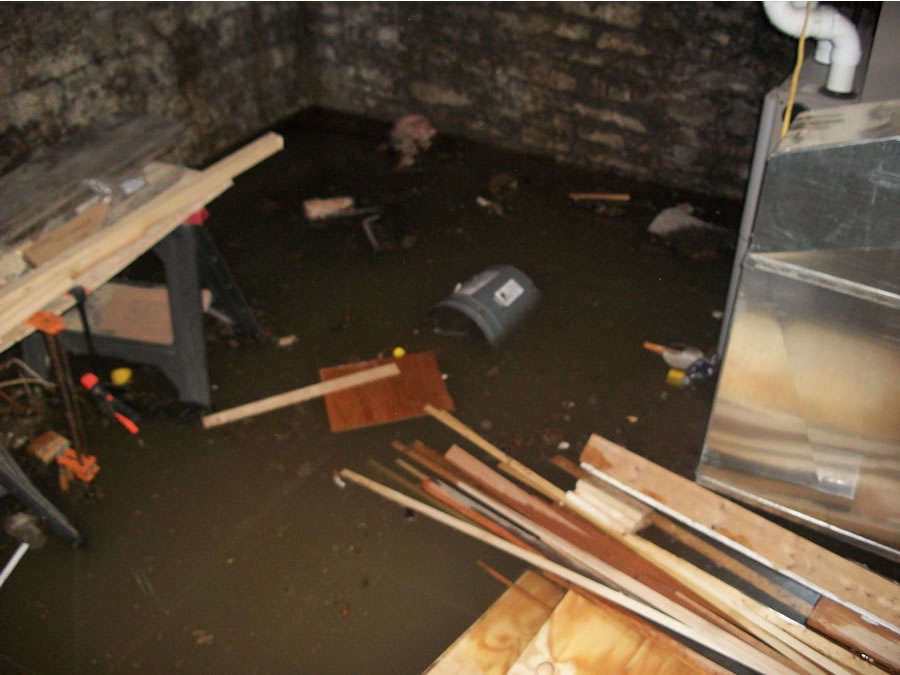
And this is what our basement looked like at dawn this morning:


I've been up right now since 2am.  I caught the basement early in the flooding, but Charles and I couldn't do a darn thing to stop it.  It was too dark at 2am to see it, but the creek had risen so high that the tile the sump pump drains into was itself underwater.  Because of this, no matter how long the sump pump ran it was unable to push any water out.  The water in the basement just kept rising.  God bless the crew from the local heating and plumbing company (same ones who installed our furnace & heat pump) who came out at 4am.  By 6am they had figured out the problem and had rigged a temporary tile that is by-passing the buried tile.  It is still pouring water about ten feet away from the house along the hill down to the creek. 


At its peak the water was somewhere around 10-12 inches deep throughout the entire basement.  Once the by-passed drain tile was in place the sump pump ran non-stop somewhere between 5 and 6 hours to empty the basement. 

It's going to take a lot longer than that to clean up the mess though.  The back room of our basement had a dirt floor.  It now has a mud floor.


The picture below (which is of the bin that collects dirty clothes under our laundry shoot) shows how high the water reached:


When the by-passed drain went into action the water was less than an inch from reaching our furnace, heat pump, hot water heater, washer and dryer.  As it is, the only valuables we may have lost are our shop vac and cordless drill.  We were lucky we didn't lose more down there.  But our greatest possible loss is outside the house.

I don't have any pictures of the stone bridge to post here.  Most of it is still under water anyway.  Most of what is left of it anyway.  Back in my 'plans for 2011' post I said we planned to make rebuilding the bridge a four year project, but after last night our timeline has been cut drastically.  Right now the middle of the bridge is still standing, but it appears the entire east side has mostly collapsed (and the west side was already collapsed before last night's storm).  One more backhanded slap from Mother Nature and I fear we won't have a stone bridge at all.  Our basement is one heck of a mess, but it's the bridge that has me fighting back tears. 

 So if you're reading this and have a few prayers to spare for north-central Ohio they would be much appreciated.  At least one neighboring county has been declared a "state of emergency" and based on phone calls and the internet I know that many, many of our family and friends are dealing with their own flooded homes right now.  I'd especially appreciate prayers for my parents.  In the morrow they face the not unexpected but still very painful loss of a much loved family pet.  In the morrow they will also face the continued job of salvaging what they can after pumping eight inches of water out of their own (partially-finished) basement.

So good riddance February.


(...and God-speed Redigen...)