Sunday, June 23, 2019

Angry is Just Sad's Bodyguard


I spent this morning hanging laundry on the line to dry and then beginning some overdue repairs on the wooden kitchen storm door. The chance to add a little of myself to this house's long history has always brought me pleasure. It's nice to look down as I type and see window glazing under my fingernails.

The memories recorded in the entries on this blog are probably the best tool I have to convey what this home means to me and my family; the relationships and memories that I treasure about this place, and the hopes I have for a future here. I have started this post multiple times in the past 15 months, but have never yet found words to convey what I want to say. Even if I do share the words I write today they will inevitably fall short.

We found out in late March of 2018 that the Einsel House is in the footprint of the proposed Seneca Wind Project, an industrial wind project covering 25,000 acres that intends to build up to nineteen 600 (+/-) foot industrial wind turbines within two miles of our home. If that happens we will try to sell the Einsel House and move. It hurts to be in this position.

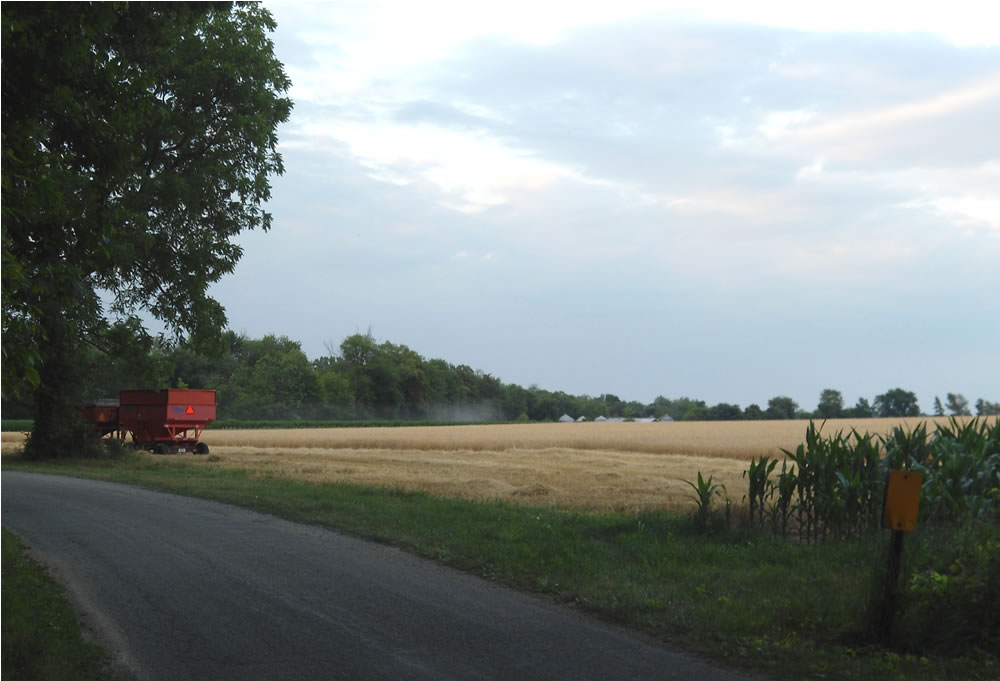
We bought this property ten years ago not only because I love this house but because we love the whole package – the tree lined creek, the open fields, the sunsets and the wildlife, the landmarks on the Google Earth map of today unchanged from the landmarks of the county atlas of over 120 years past. The history in this house drew me from the start, but there are plenty of old houses in town that we never even considered buying. The Einsel House was the perfect house in the perfect setting; it was a wonderfully intact historic home in a rural and agricultural setting. It was exactly what I wanted. (And Charles, bless him, was willing to come along for the ride.) There's no pizza delivery to our house, cell phone service can be spotty and high speed internet options limited, certain times of the year we expect to be stuck behind slow-moving farm machinery, and some days we can smell the new livestock barn built south of our home. We expected all of those inconveniences when we moved here. But we never expected our home could be in the middle of an industrial energy complex that would change the light, the sound, and the view. In short, industrial wind would take away many of the reasons we chose to live here in the first place.

Home is supposed to be your sanctuary. It's hard to explain what it does to you when the place that has been your respite is suddenly the constant source and reminder of your stress.

Coming home from work and immediately noticing that the kids turned off the TV when they were done playing video games but once again forgot to turn off the old Xbox 360. The sound of the disk still spinning has always annoyed me. Charles measured that sound last summer at 37 decibels. The company planning the Seneca Wind Project estimates wind turbine noise at our house will be 41-44 decibels. And I won't be able to turn it off.

Appreciating a beautiful sunset and turning to Charles to say, “Look at that beautiful sun - ” but stopping mid-sentence with the realization that this is the exact time of day we will have shadow flicker once the turbines are built.

Setting outside in the early evening to enjoy watching the Einsel bats fly out into the night. But this summer I always have paper and pen in hand, recording not only the number of bats but also the temperature, cloud cover, and visibility of the moon. Knowing that the data I collect will become part of the baseline for a mortality study on bats if the Seneca Wind Project is built. (Prior to learning my home could be in a wind project I had no idea that simply flying too close to a wind turbine is fatal for bats. The change in air pressure near moving turbine blades causes the fragile blood vessels in bat lungs to explode, thus the bat drowns in its own blood.) And thus wondering if I sit outside in future evenings, how many fewer bats will I count?

Avoiding a familiar route so you don't have to see the painfully slow process of removing a scenic tree line. Wondering every time you do pass how much more destruction will follow as narrow rural roads are widened to accommodate massive industrial machinery.

Sitting immediately beside Ohio's most pro-wind State Senator, Matt Dolan, during a meeting in Tiffin last fall and being shocked when he openly acknowledged that the wind industry would be a “burden” on this community. Then feeling much less shocked when he wondered aloud if an adjustment to PILOT payments and resultant increase in local tax revenue would make Seneca County more accepting of this “burden”. (The Dolan family are majority owners of the Cleveland Indians, and I have not watched or listened to a game yet this season that I haven't been reminded of Senator Dolan's willingness to sacrifice my community.)

Coming home late one night, getting out of the car and looking up at a stunning, starry night sky. Then remembering that those intensely dark night skies may soon be dotted with hundreds of blinking red lights in all directions.

Getting a call from the architect you contacted a year ago, meeting with him and getting his plans for the addition we have anticipated ever since buying this home a decade ago. But feeling pain whenever you glance at his rolled up plans, because you know it makes no sense to invest the money you have been working so hard to save on a house you might soon choose to leave.

My dad has asked me, “Where would you go?” and sadly, it's a good question. Seneca Wind is the project our current house is in, but there are now multiple other additional wind projects in various stages of development surrounding this area. Republic Wind to the north and Emerson Creek Wind to the east are already progressing through the Ohio Power Siting Board process. And it appears that the communities where I was raised and married are about to find out they are the proposed site of another project called Honey Creek Wind.

Over a year into this fight I am as angry as ever at the wind industry's unwillingness to recognize any sanctity in setting. As time passes though I have grown increasingly saddened by the realization that this industry not only undermines and damages long-standing expectations of place that residents have typically (and understandably) taken for granted, it also undermines and damages individuals, relationships, and the fundamental social fabric of communities. It does this intentionally and unapologetically.

Those who speak up in opposition to wind energy are lambasted as backwards, unintelligent, 'flat-earthers' who are against clean energy and have no concern for the environment. They are accused of being selfish and of wanting to control their neighbor's property. They are labeled as puppets of dirty energy, and any organized anti-wind effort is assumed to be funded by coal or oil. I cannot hope to address each of these accusations here, but I assure you that none apply to the anti-wind movement as I have seen and participated in it here in Seneca County.

But there is another group that I suspect feels equally attacked when the wind industry enters a community – those who own land leased to a wind company. These are accused of being gullible, greedy and money-hungry; willing to sell out their neighbors for their own financial gain. Here I cannot claim personal experience, nor will I try. Neither will I paint with a broad brush, nor imply that all leaseholders acquired that title through the same process or prompted by the same motives. What I will do is state that I have seen just as much pain and torment among some leaseholders as I have among the most fervent of anti-wind non-leaseholders.

Consider the following:
-Leaseholders who had concerns but signed the lease because they were asked to so by other family members.

Part of a public comment on the Seneca Wind Project filed with the OPSB


-Leaseholders who did not sign any lease, but purchased or inherited land with a lease already in place.  Some in this group did not even realize until much later that the land they had purchased/inherited was subject to a wind agreement.  Among those who were aware, many assumed that because the leases were years old the wind company had abandoned the project and the lease would simply expire and be forgotten.  

Situations like these were in the back of my mind some months ago as I watched the documentary Windfall a second time. When I first watched Windfall in the spring of 2018 I identified with the residents opposed to turbines being built in their community. But when I watched the documentary again this spring it was several statements made by pro-wind residents that stood out to me.

“I never thought it would be so contentious an issue. It's really divided our community and I didn't see it coming. I guess I should have....It's been difficult for my family. My wife has taken the divisiveness and the rancor and the anger...she's taken that to heart. It's hurt. And I think we'll both be glad when it's over.” - Frank Bachler, Town Supervisor

“It isn't all gravy for the landowner. But it seemed like a small price to pay for what we thought was the public good. And then time goes by and all of a sudden we are the bad people. We are the bad people! Oh my word! The neighbors are having meetings at their house; what to do about the Hamiltons....they are the bad people. We've got to stop 'em somehow.” - John Hamilton, Leaseholder


These words were still rattling around in my head, bouncing around with my own experiences from the past year, as the end credits began to scroll on the screen in front of me. And I saw that Windfall was released in 2010. Almost a decade ago. That really caught my attention.

One of the many nights that we've been up too late talking about this issue Charles made the following statement, “Whoever controls the narrative wins.” He is absolutely right, and I'm convinced the wind industry knows this as well. This industry knows what it does to the social fabric of a community; it knows the division it sows within families, within churches and community organizations. And yet I believe when wind companies approach potential leaseholders they  emphasize how beneficial and welcome these projects are. The division that communities suffer in the wake of industrial wind is minimized (or completely omitted).  Because when courting potential leaseholders it is the wind company that controls the narrative.

“In the beginning I just thought our community will embrace this. I was very naive.” - Frank Bachler

I have talked to numerous leaseholders here in Seneca County and all of them have expressed surprise at how quickly this issue divided the community following the public announcement of these projects. None expected this issue to be so divisive.

This community division may have taken my neighbors by surprise, but I'm convinced it was no surprise to the wind companies targeting this county. Windfall was released in 2010, yet in so many ways it is the same story unfolding nearly a decade later here. A decade later and the industry continues to follow the same community-wrenching script. The more I reflect on this the angrier it makes me. Any individual who is offered a wind lease has the right to know the consequences of signing the dotted line. They have a right to as much information as possible – and that should include knowledge of how their neighbors feel about the project. Yet not only does the wind industry not provide this information, it has perpetuated a system that intentionally obscures this information.

I don't believe the companies behind Seneca Wind, Republic Wind, Emerson Creek Wind, Honey Creek Wind, or any other project lurking behind the scenes really care about the people of Seneca County. Instead, I believe the wind industry sees people as obstacles to be overcome. Those who do not own enough land to matter to these companies are left in the dark until the 11th hour. Those who do own enough land are wooed with a carefully selected narrative long before the 11th hour. Thus the division is set before that critical time.  As a result, land owners are encouraged to sign a lease believing it will benefit their community only to later and suddenly realize that many in their community do not see wind energy as beneficial.

Here in Seneca County we are now fifteen months past that 11th hour. Our rural landscape remains intact for now, but the social fabric of this community has already suffered too many tears. Perhaps the cruelest torment inflicted by the wind industry is suffered by those who unexpectedly feel villainized by their neighbors and friends. This is sadder still because if you ask those neighbors and friends to identify the villain in this saga I guarantee you will hear in reply the name of a wind company and not the name of a leaseholder. Anti-wind does not mean anti-neighbor.

I wrote somewhere back at the beginning of this post that even if choose to make this post public I would inevitably fall short of everything I wanted to say. I was right.

(As a postscript - Thank you for the many kind responses to this post.  Although for this post I have chosen not to publicly share comments please know that your words are appreciated.)


Saturday, March 5, 2016

Winter Scenery

Yesterday morning provided perhaps the most beautiful scenery yet this winter.  And thanks to a new job where that scenery translated into a two hour delay, I had time to put on some boots and enjoy a quiet morning walk through the snow. 


(Did you notice the springhouse is in the picture above?)


Saturday, July 19, 2014

Kitchen Update

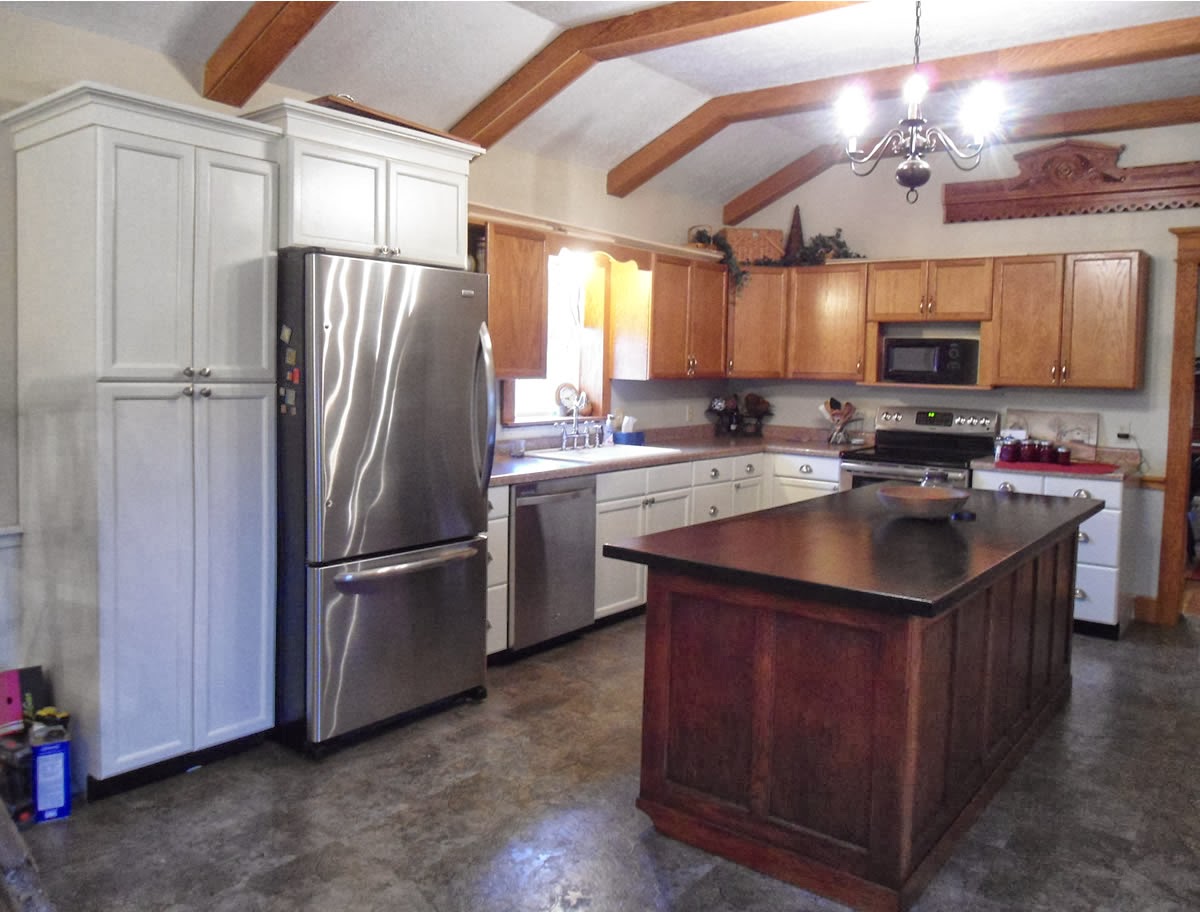
I took advantage of a tidy kitchen today to snap some photos so I could update anyone who happens to stumble by my poor neglected blog.  As a (weak) excuse for the lack of posts here, I admit that a full year passed between the first builders grade oak cupboard door coming down and the last white-painted cupboard door being rehung.

So, for a quick review, here's the kitchen in 2009:


In 2011:


In 2013:


And today:


I'm rather proud of the fact that I did about 95% of this work by myself.  Painting helped hide a few imperfections, but all in all I'm quite happy with how everything turned out.  I did have help from my mom who cut all the arched brackets in her shop.  The little arch along the side of the refrigerator was her idea, and it's one of my favorite little details.  

I also had help from my uncle J, who moved an outlet and handled the electrical end of installing the new hood range.  As the earlier pictures show, the microwave used to set on a low shelf just above the stove.  The shelf was so low that it made using the stovetop awkward and dark.  It also seemed to be perpetually covered in grease and every other kind of cooking gunk.  The new hood is a basic model, but I love having the extra light and height when cooking. 


I also love the sink area.  I splurged on a new bridge style faucet and a mini-chandelier that matches the larger chandeliers in the kitchen and dining room.  Mom's brackets show up here at both the top and bottom of the upper cabinets, and I also like the new beadboard backsplash.  The laminate counters were a budget concession, but I'm still much happier with the mottled tan of the new counters than the garish green of the old. 

Like everything else around here, there are still a few details I'd like to tweak (like painting the dark toe-kick areas and adding little arches in front of the toe-kick to give more of a furniture look to the lower cabinets) but for now I'm calling the kitchen good. 


Thursday, October 24, 2013

If I Made a Million Dollars

by Cecilia (age 8 and apparently the future patron saint of old house lovers)

(click the picture to view larger)

Monday, September 30, 2013

The Current Project

The biggest project undertaken here during my blog absence (other than having a baby) has been the kitchen.  Here's what the kitchen looked like when we bought the house almost 4 years ago:


By 2011 we had progessed to this:


That's pretty much how the kitchen stayed until this year.  In January we replaced the sink, faucet and counters.  We also added a dishwasher (a much appreciated Christmas gift from Charles' parents).  In June I began painting and replacing hardware on the cabinets.  Starting with the lower cabinets and going section-by-section, I've made it to this:


It's been slow progress - but it's still progress.  : )  

Friday, September 20, 2013

Fourteen months later...

After a fourteen month absence I'm quite surprised by the number of people who still ask when I'm going to have another post here.  I guess I finally have an answer for them. 

Anyway - fourteen months.  A lot can happen in fourteen months.  Let me see if I can recap some of the highlights:

Purchased and refinished one of the surviving window surrounds from the 1884 Seneca County Courthouse.

Installed reconstructed original window in the springhouse.  (The other one is ready to install, but for now the opening is covered in plastic.)

Refinished one of the original house doors that had been in the shed and hung it on the second door to the former computer room so we could use it as a nursery.

Planted asparagus, rhubarb and red raspberries.  (The raspberries are everbearing and are in their second harvest right now - yum!)

Canned 16 pints of raspberry jam and 13 quarts of homemade spaghetti sauce.  Also froze 12 quarts of homemade freezer salsa, and 16 quarts of diced tomatoes.

Bought an antique corner cupboard for the dining room at an estate auction.  It's the first piece of furniture we own that's roughly the same age as the house.

Painted and replaced hardware on the lower kitchen cabinets.  I'm currently working on painting, adding crown molding and changing hardware on the uppers.

And last but certainly not least - we added Jonathan Paul to the family! 


(Did you catch the hint I snuck in there above?)  The little guy is almost five months old already and is quite the peanut.  After trying early February and late July, I've decided that spring is the best time to have a baby.  Jonathan has loved being outside from the day he was born.  He's also been a pretty good sleeper right from the start.  (Although there's always room for improvement!)

So, the crazy late nights and constant projects of 2009 and 2010 are long gone, but the Einsel House remains a work in progress.  To those who have persistently encouraged me to keep the blog alive - thank you.  I can't promise anything, but I will at least try not to take any more fourteen month absences.  : )

Wednesday, July 11, 2012

The Good Old Summertime

The last few days have been classic summer.  On Sunday we had a family reunion and then I took the kids on the local preservation society's annual garden tour.  I thought the kids' patience would last through maybe four or so gardens, but they wanted to see all eight.  I've got some great kids!  Then for supper last night I enjoyed a big plate of sauted zucchini, red onion and tomato with some lemon pepper seasoning.  Mmmmm!  And the zucchini came from my own little garden:


I'm putting all those salvaged bricks to good use!


Wednesday, June 27, 2012

A Sunday Stroll

The heat of the day was starting to pass and it seemed like a lovely evening for a walk, so I told Charles the route I planned to take and I set off.  I'd walked most of my planned route before.  But then Charles had dropped the kids and I off on the creek road and we walked back home. Tonight I was by myself and I decided to make the route into a loop.  It only meant adding one last section of road at the end of the walk.  So...

A glance back at the house from the end of the drive.
0.2 miles - a brief stop to visit a few graves in the Primitive Baptist Cemetery, including Elder Lewis Seitz who married the Einsel House's first owners, Noah and Rebecca Rhinehart (he was also Rebecca's uncle)

0.4 miles - peeking out behind those pine trees is another 1840's stone house

0.8 miles - the setting sun shining through clouds

1.1 miles - crossing Silver Creek, site of the first mill in this township

1.3 miles - turning left onto a township road, this is the longest stretch ahead of me

1.8-2 miles - I enjoy a few black raspberries growing along the side of the road

2.2 miles - turn right onto the Creek Road (this is the best part of the walk!)

2.4 miles - passing a wheat field during harvest
2.8 miles - Honey Creek through the trees

3 miles - This brick house always makes me smile.  I think it's the little 'eyebrow' peaks on the porch roof that do it.

3 miles - Old bridge across the road from the brick house.  The lane across the bridge leads to a barn and a pasture with a flock of sheep.

3.2 miles - a second old bridge crossing the creek

3.4 miles - This is an early log cabin, the original log walls are exposed under the front porch

3.6 miles - another right turn, back onto our own road.  It's been a nice walk, but the Einsel House is straight ahead and I'm ready to relax and enjoy a glass of water.


3.7 miles - a largish, dark colored dog at the house that's about three telephone poles ahead of me starts to bark.  I say a silent prayer that the dog is tied.

3.71 miles - the large, aggressively barking dog leaves the house and begins coming toward the road.  Slowing my pace, I say a silent prayer that there is one of those invisible fence systems along the side of the road.

3.72 miles - the large, very intimidating dog walks right up to the white line at the edge of the road.  Damn.  Nobody puts an invisible fence on the other side of the road.

Still 3.72 miles - The dog and I are both holding our ground, still more than two telephone poles apart.  Regretting the decision not to bring my cell phone with me, I decide to pass the dog by making a wide circle through the soybean field beside me.

3.73 miles - The dog is still barking angrily.  I'm about twenty feet or so into the field when it finally decides to cross the road and heads toward me through the soybeans.  Damn, damn, damn.  I'm no longer worried about getting back home, I'm just worried about getting away from this dog.  Resisting the urge to run, I begin to speed walk through the field. At the moment I really don't care that I'm now heading farther away from home, just as long as I'm getting farther away from that dog.

After a few seconds I glance over my shoulder.  The dog has stopped about 10 feet into the field.  He's still watching me and barking angrily.  Breathing a sigh of relief (but not slowing my pace) I continue walking through the field.

about 4 miles - I reach the other side of the soybean field and come out back on the creek road.  Regretting again the decision not to bring along my cell phone (or even some bottled water), I resign myself to the walk ahead of me.

4.2 miles - back past the early log cabin

4.4 miles - back past the second iron bridge

4.6 miles - back past the first iron bridge


4.6 miles - The eyebrow porch watches me walk past again.

5.2 miles - Even when I'm tired and thirsty, I still have to admit that I love the smell of freshly harvested wheat

5.4 miles - A left turn back onto the township road, but I forget to document it with a picture. 

5.6-5.8 miles -  I'm initially hopeful as I pass the section of raspberries growing along the ditch, but realize quickly that I picked them pretty clean my first time by. 

6.2 miles - I'm almost back to our road.  A right turn and just over another mile and I'll be home.   I hear a car coming up behind me, so I step off the side of the road.

But the car keeps slowing down.

I turn around and see my husband with the passenger window rolled down - "It seemed like you were gone quite a while, so I thought I'd come check on you."

God bless you, honey!

Friday, June 15, 2012

In the Details

I have enjoyed poring over the details revealed in the 1906 picture of our house that we were recently given.  In many ways the picture confirms that thus far we've been historically accurate in our work on the house.  The joint finish of the mortar in the 1906 stone walls appears to match the joint finish our masons used when they repointed the house.  And I'm pretty confident that the tan paint color we used on the house is also accurate.  Although the 1906 picture is in black and white, it is obvious that the paint used on the house is slightly darker than the (white?) dress worn by the woman in the picture.  The one difference I see between the picture and our influence on the house is the front door.  But in spite of the obviously light colored 1906 front door, I have no plans to part with my Carriage House Red front door any time soon.  : )

Click on the picture for a larger view

The picture also provides details for future work we would like to do.  We knew the house originally had shutters (the hinges are still on the 2nd story window frames), but I've pondered what color to paint the shutters when we someday replace them.  Now I know to go dark - a deep forest green seems appropriate based on the picture.  We also now know that the original first story windows have always been six-over-six.  This detail did surprise me, as I suspected the originals would have been nine-over-six.  The picket fence was also an unexpected but wonderful detail in the picture.  Adding a picket fence in front of the kitchen has actually been among my plans for this summer, so I'm thrilled to now have something to model my fence after.


And peeking out behind the horses and tree on the left side of the picture is proof that the kitchen wing has been on the house since at least the early 1900s.  Having seen the intimate structural details of that wing I'm not surprised to see it in a picture from 1906. (Frankly, I'd expect to see the kitchen wing in an Einsel House picture from the 1880's.)

But of all the details in the 1906 picture, the one I've spent the most time studying is the front porch.  The Einsel House had a front porch when we bought it back in 2009, but it was obvious that porch was not original to the house.  It was also in poor condition.  So before having the front of the house repointed we removed the existing porch, planning all along to someday replace it with a more historically appropriate replacement.  Thanks to one of my mom's cousins, I even have some solid wood 19th century round porch pillars tucked in the loft of our barn. They were removed from said cousin's parents' house sometime in the 1960s and had been stored in his barn since then. When he tore the barn down earlier this year he offered the pillars to me and I eagerly accepted.  In my mind I could see them in an Einsel House porch - with simple corner pillars and an almost flat roof.   Something very similar to the porch on the house pictured below:


Compare the porch above to what the Einsel House looked like when we bought it in 2009:


 And then for fun, compare the 1906 porch to the porch we tore off the house in 2009.

(Note that the little girl is holding a doll)


The 1906 and 2009 porches had a lot more in common than I expected.  That said, they also had many dissimilarities.  The square pillars on the 1906 porch all appear to be the same size, while the corner pillars on the 2009 porch were larger than the other pillars.  Although it is difficult to see the details of the 1906 porch's roof, the picture seems to show the flat roof I expected and not the gabled appearance of the 2009 porch roof.  (Also note the black line on the stone in the 2009 picture - I suspect this marks where the original roof met the house.)  Finally, if you look very carefully at the 1906 picture you can just make out a porch rail between the two pillars on the left.   The rail appears to be very similar (or even identical) to the rail inside the house at the top of the stairs.    

While we are probably still years away from it, I'm so glad this picture came to us before we replaced the porch.  Because the porch in that 1906 picture is even better than any porch I would have envisioned on my own.   The inspiration for rebuilding the porch is now hanging in the dining room.  And every time I walk by I want to stop and study the picture for more details - you know, just in case I missed something the other 2,638 times I've looked at it.  : )